
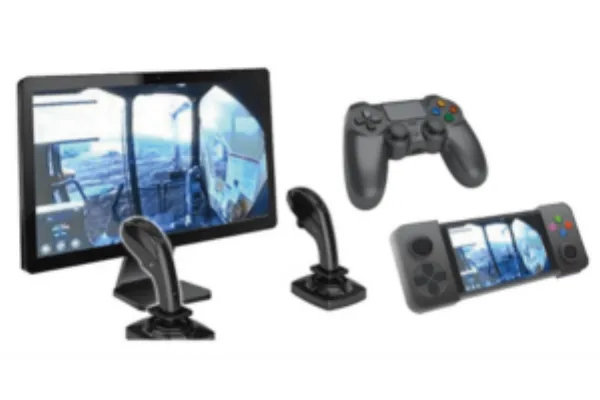
OEDO Remote Deck
Move the site, from anywhere in the world.
A universal remote operation system that works over any network and adapts to any construction machine. Even from the other side of the planet, the operator stands on site.
80–200 ms
Latency (Japan–Brazil)
4 countries
Overseas trials
8 sites
Deployments
VALUE
Three changes remote operation brings
Distance stops mattering
Operate a site in Brazil from Japan. Travel cost and time are replaced by a network link.
People away from danger
Disaster sites, steep slopes, dusty environments — send the machine where people cannot go.
More people can work
An operating environment independent of physical ability or location widens the operator population itself.
LOW LATENCY
80–200 ms between Japan and Brazil
| Video latency | 80–200 ms measured between Japan and Brazil |
|---|---|
| Against the perceptual limit | Consistently below the 250 ms generally regarded as the comfort threshold |
| How | Proprietary video compression and control protocol |
| Networks | Fibre / 4G・LTE / 5G / Starlink / on-site WiFi |
| Short range | Radio-control style operation is also supported |
STRUCTURE
System structure
OPERATOR side
-
Cockpit
3–5 monitors
-
Levers and pedals
Same layout as the real cabin
-
Network
Fibre / 4G・LTE / 5G / Starlink
MACHINE side
-
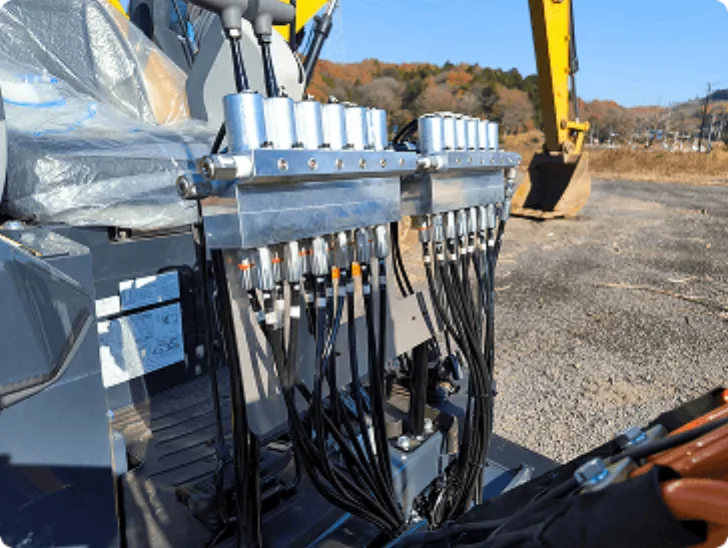
On-board unit
Relays video and control commands
-
Cameras and sensors
Surround video and machine state
-
Hydraulic actuators
Driven through the Controller
LINEUP
Cockpit lineup
Shoulder cockpit
A fixed installation reproducing the lever layout of the real cabin. Three 32-inch monitors, AC100V / 380 W. The standard configuration for permanent bases.
Mobile cockpit
A portable unit. With power and a network link you can build an operating environment anywhere.
Foot pedal
Used with the mobile cockpit; travel control moves to the feet so the hands stay on the levers.
PROCESS
How deployment works
- STEP 01
Interview
Machine, site environment and network conditions.
- STEP 02
Network survey
Feasibility check of latency and bandwidth by measurement.
- STEP 03
Machine fitting
Install the on-board unit and calibrate.
- STEP 04
Training and launch
Operator training and safety procedures, then go live.
CASE STUDIES
Case studies
FAQ
Frequently asked questions
Q Which machines are supported? add
Mainly hydraulic excavators, plus bulldozers, crawler dumps and other major types. The unit is designed to retrofit onto any machine, so replacing your fleet is unnecessary.
Q What happens if the link drops? add
It works with the emergency stop mechanism of the Controller: loss of communication puts the machine into the fail-safe (stopped) state.
Q What network speed is required? add
It depends on the operation, but stable upstream and downstream bandwidth is required. We measure and propose a configuration during the network survey.
RELATED
Related products
CONTACT
You can still operate that machine.
From confirming whether your machine is compatible to discussing a proof-of-concept trial — please feel free to reach out.